

Docs Menu
Unit Revenue with Loss Factors
Compare derived energy revenue for supported semi-scheduled wind and solar units, with and without the published marginal loss factor (MLF), side by side. Results show derived energy valuation over the available intervals, with coverage counts alongside.
From a Renewable Ranking to Unit Revenue
- Open Markets → NEM → Asset Economics → Unit Ranking. Choose the Region, Fuel (solar or wind), period, metric and sort order. Periods are Last 7d, 30d, 90d or 365d.
- Compare Regional reference price and With published MLF valuation where relevant. Find the unit in the results and note its exact DUID; there is no DUID input or map-opening action on a ranking row.
- Open Asset Economics → Unit Revenue (MLF). Enter that DUID, then press Enter or leave the field. Choose Last 7d or Last 30d (complete days).
- Read the with-MLF and without-MLF cards, stream table and market-day table together with the held, priced and factored interval counts. Times use fixed AEST (UTC+10).
Different quantity bases: the ranking example uses metered SCADA output; this renewable revenue view uses dispatch targets. Matching the unit and dates does not make those quantities identical. MLF changes valuation, not physical MWh or capacity factor. Realised price in the ranking is output-weighted.
For battery energy and FCAS revenue, use Battery Analytics, not this renewable view. See Battery Benchmarks and Index and the full walkthrough.
Watch the Video: Headroom, Curtailment and Revenue (1:10)
In Network Map Markets, open Unit Revenue (MLF) from the Asset Economics group. MLF stands for marginal loss factor.
What We Report
- Adjusted revenue = loss factor × regional reference price × MWh.
- Unadjusted revenue = regional reference price × MWh.
The loss factor is the market operator's published transmission loss factor for the unit's connection point. Here it adjusts the energy valuation. These estimates do not include contracts, hedges, operating costs or all settlement adjustments.
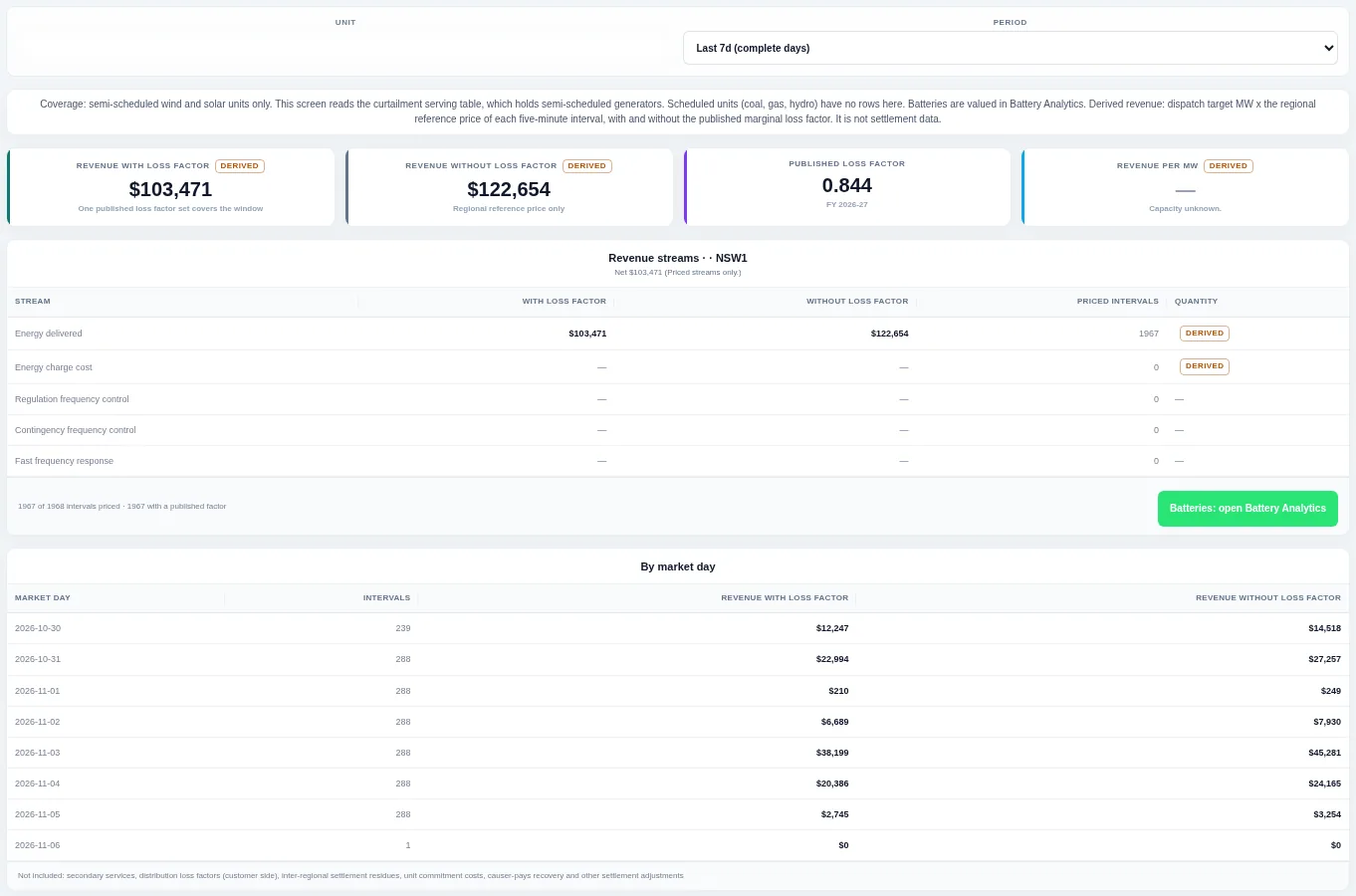
For this renewable view, MWh = dispatch-target MW × 5/60 h for each five-minute interval. The interface groups results by market day; its controls are DUID and complete-day period, not a separate resolution or custom-date picker.
Revenue Streams
The renewable view shows energy valuation with and without MLF and identifies the quantity basis. The total includes priced intervals only. A partial numeric result can remain visible when some prices or factors are missing; it must be read with its coverage, not treated as a complete window.
Battery discharge, signed charging cost and FCAS streams are documented under Battery Analytics. Battery energy uses SCADA; FCAS valuation does not apply an MLF.
The current renewable interface accepts one DUID and a Last 7d or Last 30d complete-day window. It does not offer an MLF-set selector or a capacity input. If capacity or revenue per MW is Unknown, do not borrow a rating from another view to fill it.
Loss Factor Rules
- Loss factors come from the market operator's daily loss factor report. Each set records the source URL, the publication date, the financial year and the SHA-256 checksum of the file.
- Each interval uses the latest determination in effect on or before its market date, within the applicable financial year. Factors are not invented, interpolated, averaged or substituted from another financial year.
- A missing factor is never replaced by 1.0. The affected interval cannot contribute an MLF-adjusted value. A window can still show a partial sum from covered intervals; inspect the reason and coverage counts.
Data Sources
- Dispatch-target MW and regional price for each available interval, from the market operator's public dispatch data. These are not the SCADA quantities used in the renewable ranking example.
- Published loss factor sets, with source and financial-year metadata. A stored set does not imply that every selected unit and interval has a usable factor.
Coverage
Check expected, held, priced and factored intervals for the selected window. Missing prices, factors or capacity must remain explicit. In the recorded GLRWNSF1 example, coverage was partial and capacity and revenue per MW were Unknown; the ranking page's capacity was not substituted. A different unit or period can have different coverage.
Related Guides
- Market Intelligence Walkthrough
- Curtailment and Missed Revenue
- Battery Benchmarks and Index
- Network Map Markets Guide


