Market analysis of 7 November 2026
An energy project can serve several parties: the site host, asset owner and other commercial participants. Sharing its value is an accounting task as well as a negotiation. The first test is simple: allocated cash flows should add back to the project that created them.
Our example comes from a saved Network Map screening case reviewed on 7 November 2026. The figures are modelled in AUD. We use it to follow signed capital, revenue and operating costs through a participant allocation.
Begin With The Whole Project
The source case has AUD 500,000 of initial capital cost in model year zero. Year-one revenue and savings are AUD 149,250, with AUD 5,000 operating cost and no replacement or end-of-life cash flow in that year. Its year-one net is therefore AUD 144,250.
Costs enter the ledger with negative signs and receipts with positive signs. Retaining those signs through allocation is important. A participant’s share of project value includes the costs assigned to that participant, not just a percentage of the positive revenue line.
The saved example assigns 60% of every core stream to the site owner. The remaining 40% stays explicitly unassigned. This makes the complete project visible while the commercial allocation is developed.
Split Each Signed Stream
For initial capital, the site-owner share is −AUD 300,000 and the unassigned share is −AUD 200,000. For year-one revenue and savings, the shares are AUD 89,550 and AUD 59,700. Operating costs split into −AUD 3,000 and −AUD 2,000.
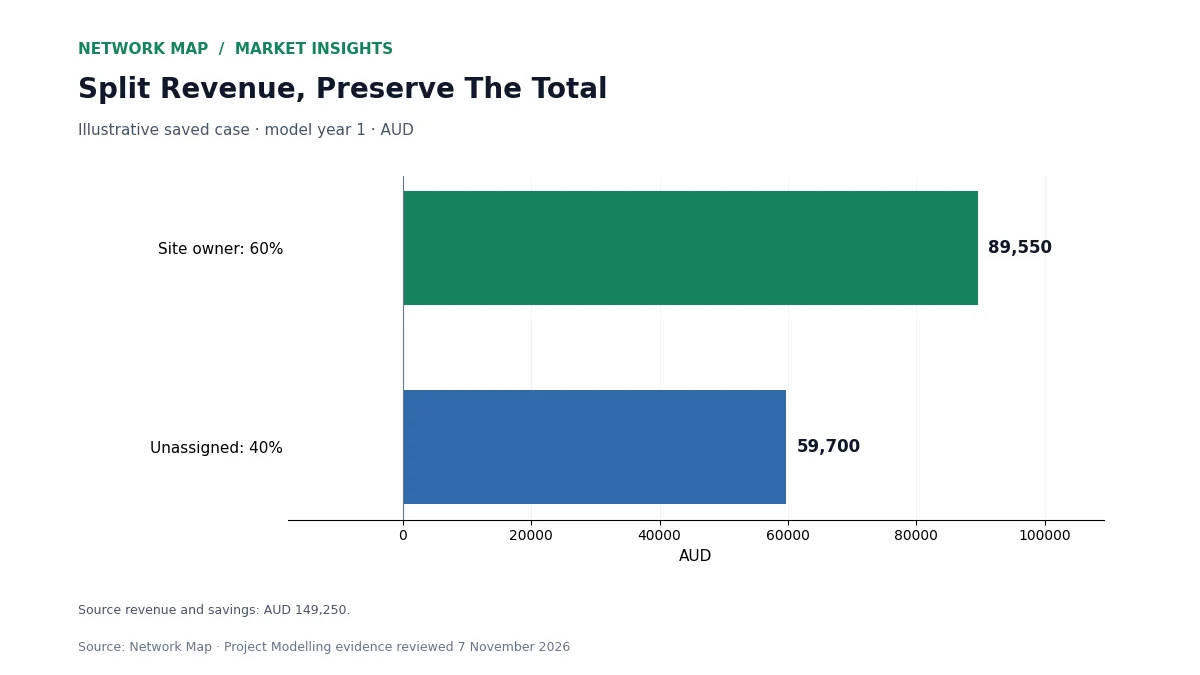
The derived year-one net is AUD 86,550 for the site owner and AUD 57,700 unassigned. Together they reconcile to the source AUD 144,250. Keeping the remainder visible is what makes that reconciliation possible.
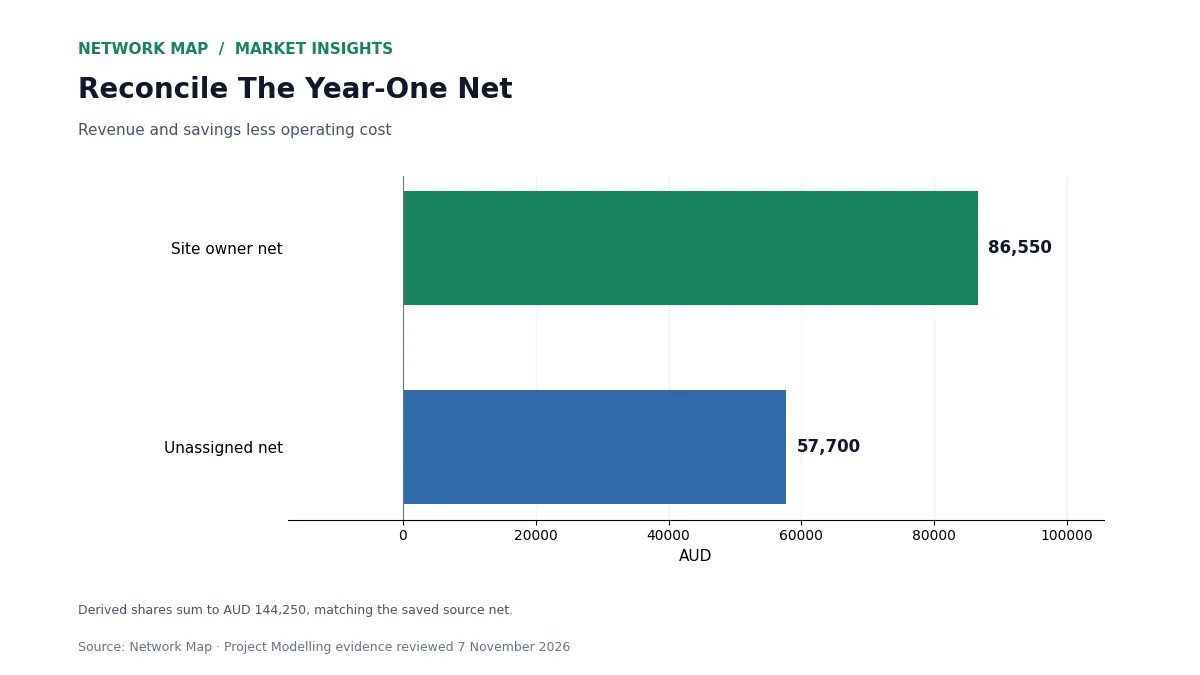
The saved product ledger reports reconciliation across all 21 model years, including year zero, and contains 130 rows. The annual check is a useful summary; the full ledger preserves the stream-level trail.
Allocation And Dispatch Answer Different Questions
Ordinary value allocation divides the economics of the saved case. Physical dispatch decides how equipment operates. Keeping these operations separate allows a commercial split to be reviewed without silently changing the energy result underneath it.
If a study instead asks equipment to pursue a participant-specific operating objective, that objective belongs in a separate saved dispatch configuration. Name the selected party, the tariff cost shares and the direction of the objective. Then run the physical case and inspect its energy result before interpreting participant returns.
The distinction matters in shared projects. A party can receive a share of revenue without that share being an instruction to the battery. Equally, a selected operating objective can favour a defined cost component while leaving other project cash flows unchanged.
Keep A Commercial Trail That Reconciles
- Define parties and stream-specific shares explicitly.
- Preserve negative costs as well as positive receipts.
- Retain unassigned value until a party is actually specified.
- Save the allocation with the case revision and read the saved result after rerunning.
Follow Participant Allocation to create the signed ledger and inspect participant returns. Use Dispatch Calendars And Sizing when the question involves changing physical operation. Value And Finance connects the shared cash flows to the investment horizon, while Revenue Reconciliation provides the wider reconciliation context.