Market analysis of 7 November 2026
Battery revenue stacking is often described as a list of markets. A stronger starting point is the physical budget. Every service draws on the same converter, stored energy, empty capacity and operating time. A project study should show how those claims fit together before it adds their values.
Network Map’s market-based battery estimates from December 2025 to October 2026 provide context for a modelled storage reservation reviewed on 7 November 2026. Use the market totals to explore the value mix and the saved example to follow capacity accounting.
Use Market Values As Context
Across the 335-day market-data period, the tracked fleet’s estimated net energy value was AUD 296.78 million. Estimated ancillary-service value was AUD 19.82 million. These market-based estimates use observed operation and regional prices.
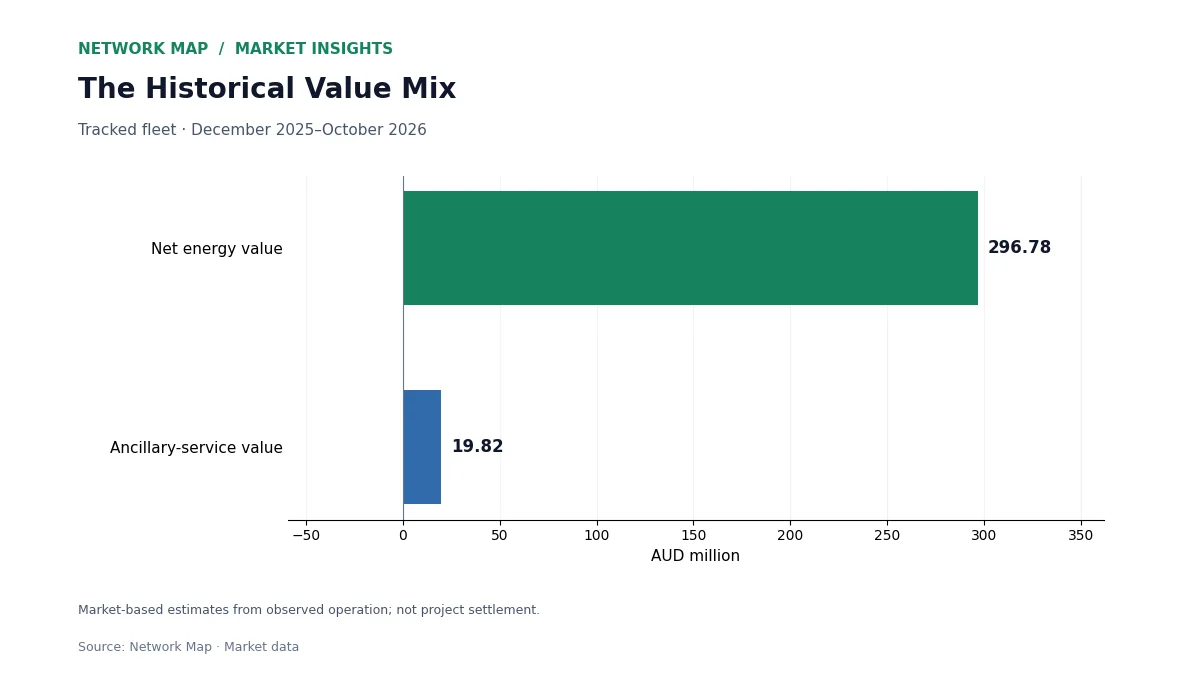
The tracked discharge volume was 4.04 million MWh, rounded. The mix shows why an energy-only view and a multi-service view can differ. Model a new battery with its own dispatch, cost, availability and commercial assumptions.
For a deeper historical comparison, our battery margin analysis follows regional values. Here, the focus is the physical capacity that supports a proposed service stack.
Reserve Power Before Allocating It Again
Our saved example uses a 2 kW / 4 kWh battery. A raise-service acceptance block reserves 0.0001 MW, equivalent to 0.1 kW, for 60 minutes. The minimum block is also 0.1 kW. The saved export records the reservation as reserved with a modelled qualification check.
Subtracting the reserved block from the 2 kW converter leaves a nominal 1.9 kW power budget before the other operating constraints are applied. The reserved block corresponds to 0.1 kWh of AC service energy over one hour. The storage calculation then applies its efficiency, charge-state and throughput conditions.
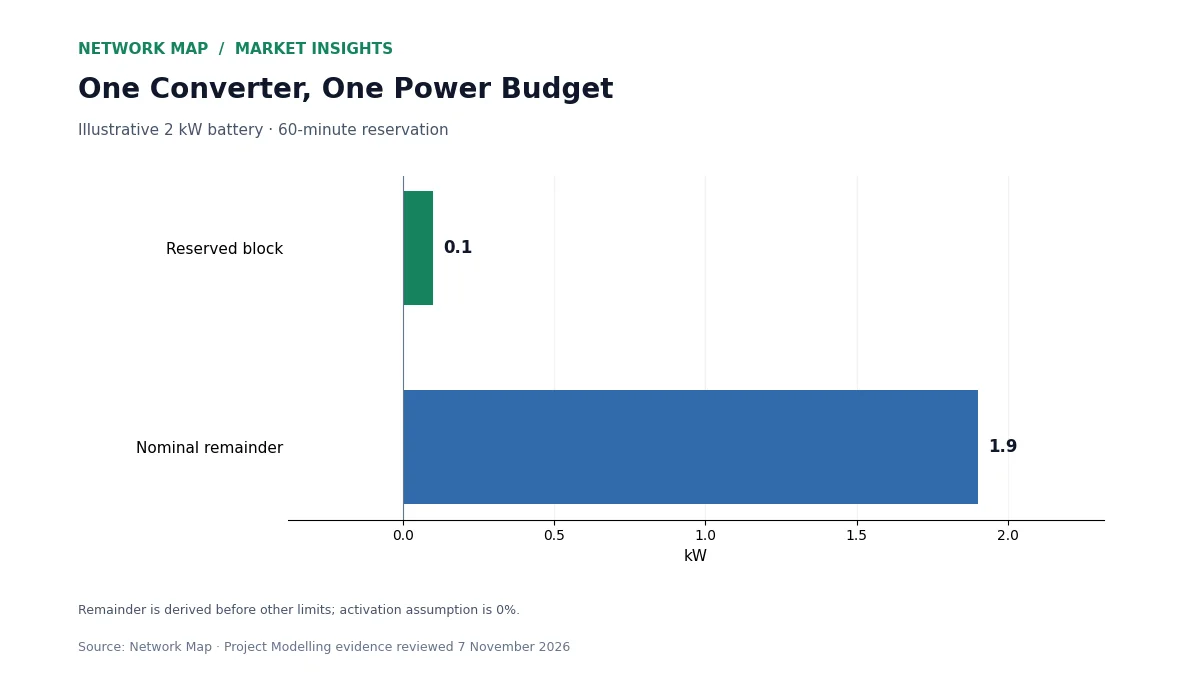
This is why a reserve commitment belongs in the dispatch study, not only in the revenue spreadsheet. Raise service needs stored energy available. Lower service needs room to absorb energy. Both directions share the converter power pool.
Keep Reservation And Delivery Distinct
The example assumes 0% activation and returns AUD 0 ancillary receipt. It shows how to reserve capacity and test the physical service obligation in the dispatch study.
A commercial case can then introduce its dated prices, acceptance and activation assumptions. Keep each saved version with the run. When a payment replaces an existing energy receipt, reconcile the removed credit as well as the new one. When it is genuinely additional, identify the separate service being purchased.
Across multiple venues, every service uses the same physical asset. Keep the capacity ledger consistent across every proposed revenue stream.
Build The Stack From Physical Rights
- Start with converter power, available energy and operating windows.
- Reserve accepted service obligations before allocating remaining capacity.
- State activation and price assumptions separately.
- Reconcile every receipt against the energy or service right that earns it.
Use Contract Settlement to save reservations and inspect their evidence. Dispatch Calendars And Sizing explains operating bounds. Battery Revenue Benchmarks provides the separate historical market view.