Market analysis of 7 November 2026
Demand response turns a change in consumption into a commercial quantity. The important question is not only whether a site used less energy. It is how the agreed baseline, event window and delivered response connect to the payment ledger.
Network Map provides both saved event modelling and standalone settlement calculations. The modelled examples below were reviewed on 7 November 2026. One follows a saved January event; the other prices declared delivery for a November hour. Keeping them separate shows where each number comes from.
Define The Event Before Calculating Delivery
The saved event begins at 18:00 UTC on 5 January 2026 and lasts one hour. The authored commitment is 0.002 MW, equivalent to 2 kW. Multiplying that power by the event duration gives required response of 0.002 MWh, or 2 kWh.
The case-history baseline uses earlier eligible days at the same local clock slot, with a 14-day lookback and a minimum of one sample day. The run finds 4 sample days and an estimated baseline of 0.8708333333 kW. The saved result retains that baseline as an unverified case estimate, so its provenance stays visible.
This baseline is a distinct input to the delivery assessment. It should travel with its sample dates, eligibility rule and event axis. The committed response remains a contract quantity, rather than a replacement for the baseline.
Keep The Shortfall In The Ledger
The saved event reports 0 MWh delivered response and 0.002 MWh shortfall. The example terms specify AUD 100/MWh for response and AUD 200/MWh for shortfall. The resulting penalty is AUD 0.400 and the settlement is −AUD 0.400.
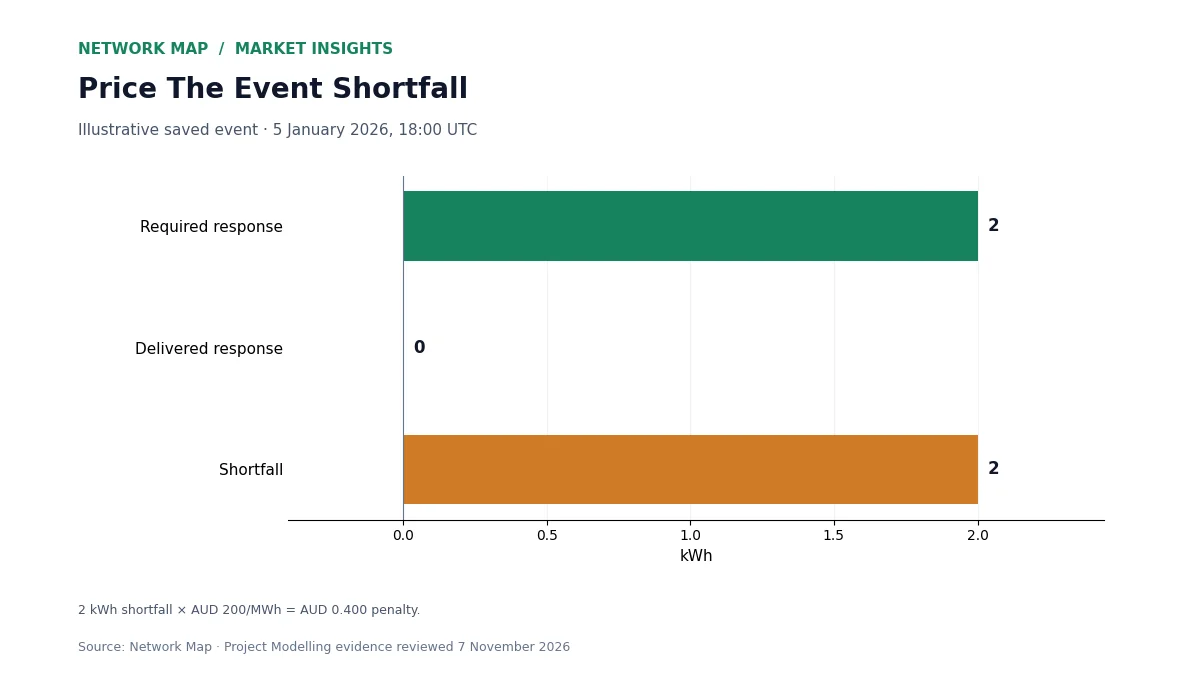
Follow the complete chain in this modelled event: committed power becomes required energy; the delivery calculation produces a shortfall; the authored penalty prices that shortfall.
A signed ledger makes the result interpretable. A payment and a penalty should remain separate components until they are reconciled into the event total. The reconciled total gives the net event receipt.
Separate Total Payment From Participant Receipt
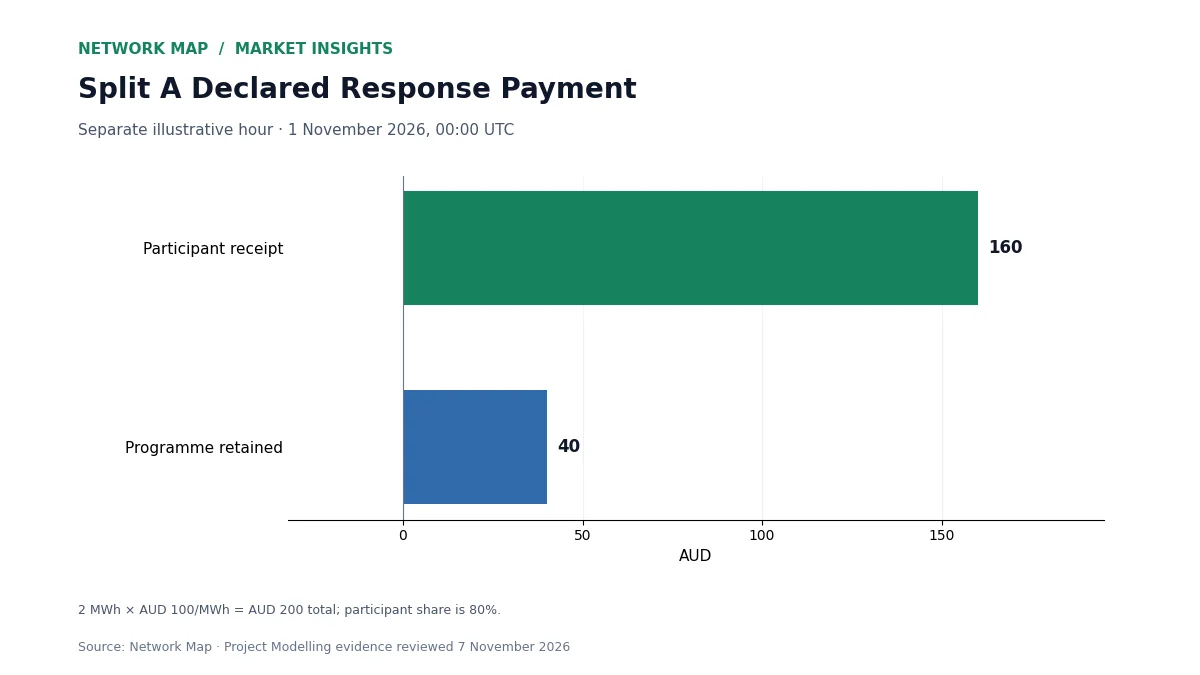
A different standalone example covers 1 November 2026 from 00:00 to 01:00 UTC. It declares 2 MWh of delivered response, a 2 MW commitment, a payment rate of AUD 100/MWh and an 80% participant share. The event is called, with reference price AUD 70/MWh and a dispatch threshold of AUD 50/MWh.
The product returns AUD 200 total settlement, split into AUD 160 participant receipt and AUD 40 retained by the programme. Those are components of the same total, not extra receipts to add on top.
The November example prices supplied delivery. The January example derives delivery against an earlier-case baseline. The two workflows answer different questions, and their provenance labels preserve that distinction.
Create A Reviewable Response Study
- State the event start, duration, commitment and units.
- Retain the baseline rule and its eligible history.
- Keep declared delivery distinct from a baseline-derived estimate.
- Reconcile response payment, participant share and any shortfall penalty.
Use Contract Settlement for event terms and the exported ledger. Profiles And Inputs covers the interval evidence. Review the surrounding price conditions separately in Markets.