Market analysis of 31 October 2026
A regional electricity price is not always the final price basis at a generator’s connection point. A published loss factor scales the reference price for settlement-value calculations. To make that adjustment traceable, match the unit, effective period and interval energy before multiplying.
This retrospective example uses Network Map’s stored factor snapshot published on 31 October 2026 and matched dispatch and regional prices from 15 October 2026. It follows the solar unit BROKENH1 in New South Wales. The result is a dispatch-based energy-value proxy, with the factor provenance retained alongside it.
Define The Physical Interval Window
Our selected records contain 12 five-minute intervals, each with dispatched output of 30 MW. The source timestamps are interval ends, from 02:00 through 02:55 UTC on 15 October. The physical covered window therefore begins at 01:55 UTC and ends at 02:55 UTC.
Each interval represents 2.5 MWh, calculated as 30 MW multiplied by 5/60 of an hour. Across the selected window, the energy proxy totals 30 MWh. These quantities come from dispatch targets; a metered settlement reconciliation would use its own meter evidence.
The timestamp convention matters. Treating an interval-end timestamp as its start would shift the price/output join and change the period described. Keep the convention in the source manifest as well as the chart label.
Match The Published Factor To The Unit
The selected published factor is 0.8436 for the effective year from 1 July 2026 to 30 June 2027. The stored snapshot was published on 31 October, so this analysis explicitly applies that later snapshot retrospectively to the October dispatch window.
The unadjusted value is the sum of interval MWh multiplied by the corresponding regional price. The adjusted value applies the unit’s factor to those same matched quantities. Our selected window gives AUD 2,561.09 before the adjustment and AUD 2,160.54 after it, rounded to cents.
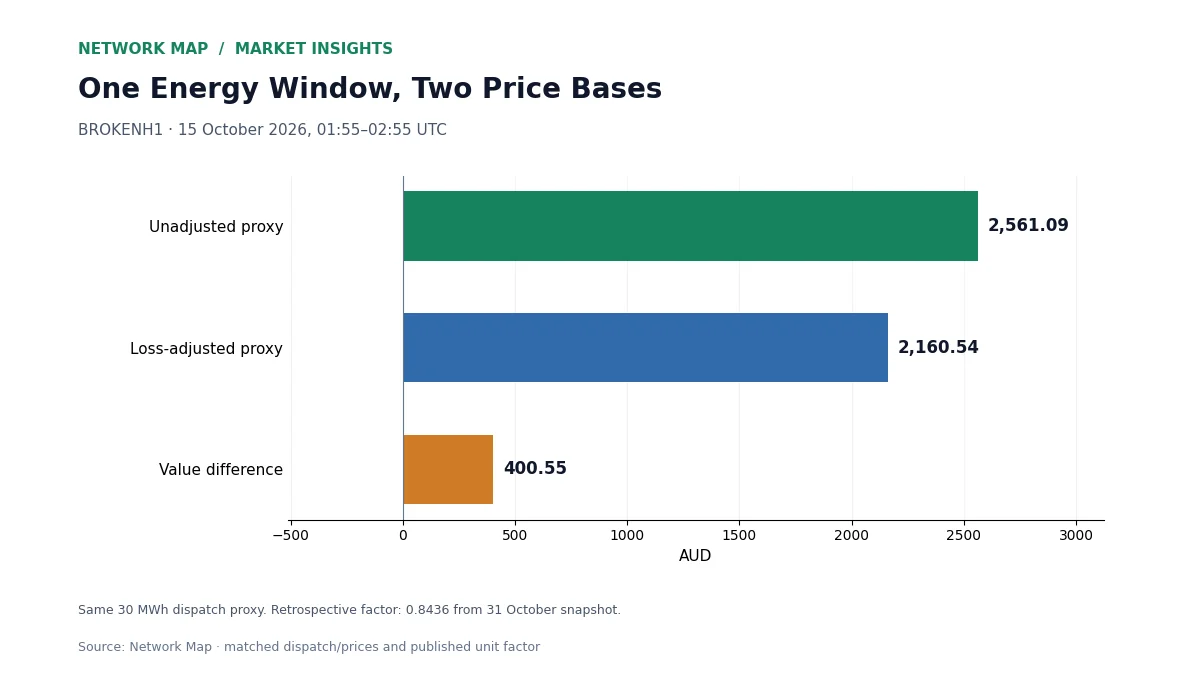
The difference is AUD 400.55, or 15.64% of the positive unadjusted value in this window. That percentage describes a change in the settlement-value calculation. The physical energy proxy remains 30 MWh; the factor ratio is not a measurement of electricity lost along a line.
Check One Interval Before Adding The Day
The first selected interval ends at 02:00 UTC. Its regional price is AUD 83.99/MWh and its energy proxy is 2.5 MWh. Multiplication gives AUD 209.975 before the factor. Applying 0.8436 gives AUD 177.13491.
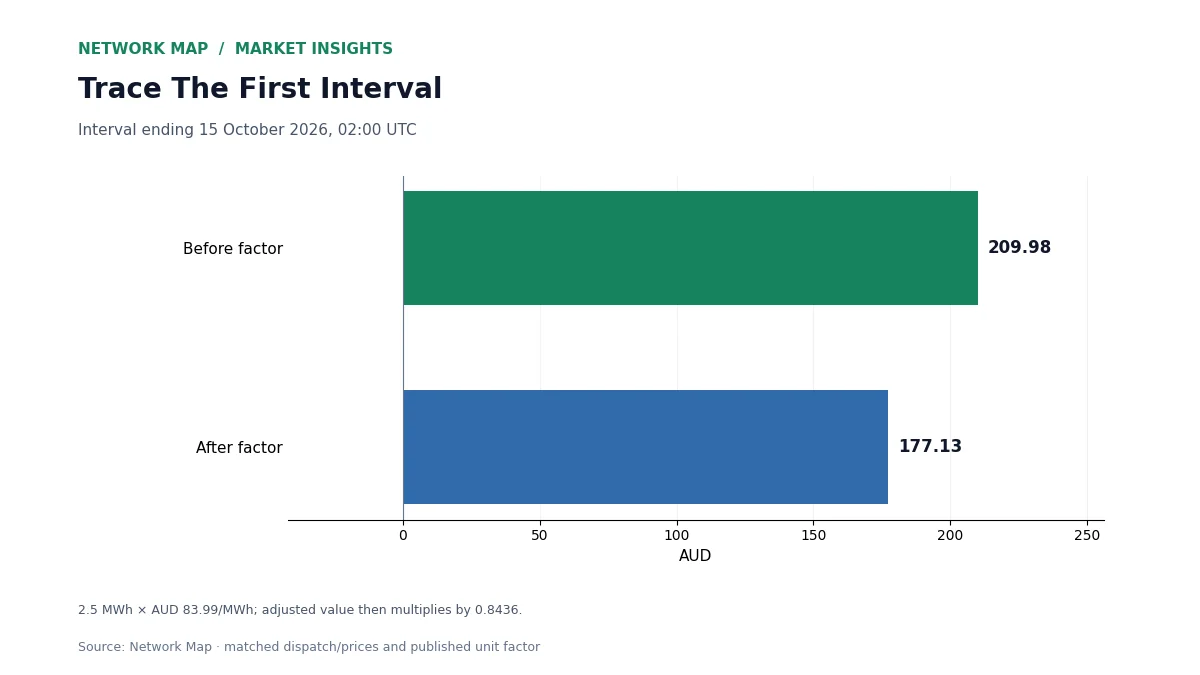
Displayed to cents, those values are AUD 209.98 and AUD 177.13. Sum the unrounded interval values before rounding the aggregate. That preserves the reconciliation between the individual records and the selected-window totals.
Keep other commercial components in their own lines. This example isolates the regional energy price, dispatched energy and transmission loss-factor adjustment. Ancillary-service payments, distribution adjustments, fees and operating costs belong to their respective evidence and ledger components.
Preserve The Version With The Revenue View
- Identify the exact unit and source timestamp convention.
- Use the factor determination applicable to the interval’s effective period.
- Retain the source publication date and checksum with a pinned factor version.
- Show adjusted and unadjusted values beside the same energy quantity.
The Unit Revenue With Loss Factors guide explains the interval calculation and versioned source evidence. Open Markets for the unit view and Revenue Reconciliation to connect the signed value components.